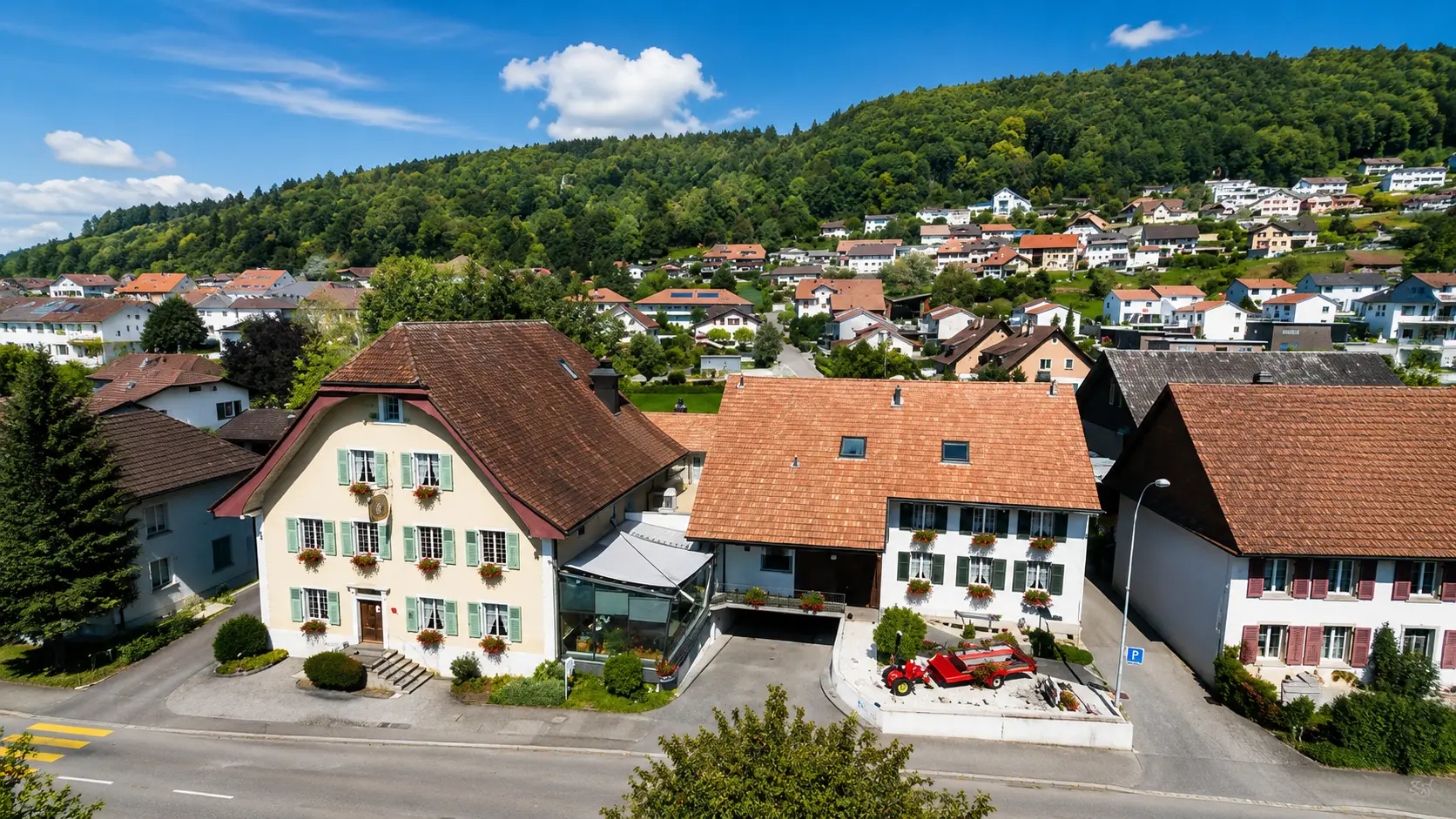
Tradition seit 1722 · Egerkingen
Geschichte des Gasthof Kreuz Egerkingen
Über 300 Jahre Gastlichkeit – von der Taverne mit Tavernenrecht 1722 bis zum heutigen Gasthof. Eine Chronik in Jahrzehnten.
Read our history book
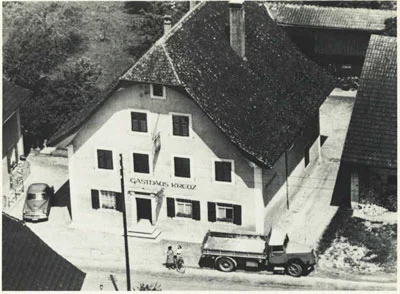
In 1722, the Kreuz was built as a large residential building with tavern rights. Time and again, new generations have made good use of the business opportunities with great commitment. As a result, many families, farmhands, and maidservants had enough to eat, work, and a roof over their heads. Not all Kreuz innkeepers were as famous as Captain Urs Josef Hammer (1779-1843) or as consistent as the Schär family, who ran an inn and butcher's shop for three generations (1906-1987). The continuity in this historic building is impressive.
Chronicle: Gasthof Kreuz & Egerkingen municipality (1660–1670)
🏘️ Municipality of Egerkingen
- Egerkingen is located on a debris cone at the southern foot of the Jura Mountains, strategically positioned between Olten and Oensingen.
- The region is part of the former county of Härkingen, which was gifted to the Bishop of Basel in 1080.
- In 1402, Egerkingen became part of the Solothurn district of Falkenstein.
- Around 1666, chronicler Haffner described Egerkingen as a "paradise on earth." [egerkingen.ch]
- The population is around 400–450 people.
🍷 Gasthof Kreuz
- 1663: Christian Felber is mentioned as "alt Wirdt zue Eggerkingen." He requests the right to serve wine again.
- The council approves the sale of alcohol "on tap," but prohibits the operation of lodgings.
- The inn is not yet an official tavern, but rather a simple pub with local significance.
- Felber is also the gamekeeper in Biriswald—a sign of his local standing. [kreuz.plus]
🕰️ 1670–1680
🏘️ Municipality of Egerkingen
- St. Martin's Church is being expanded as a religious center.
- The population remains stable, and the village is characterized by agriculture and livestock farming.
- The region is affected by the Counter-Reformation and religious tensions.
🍷 Gasthof Kreuz
- 1670: Christian Felber dies. His son Niklaus takes over as "under Würth."
- Niklaus later leaves the village and moves to Freiburg.
- Urs Felber continues to run the business and requests permission to import Alsatian wine—denied.
- The Felber family is one of the most respected in the village, with connections to the Arx, Rauber, and Hammer families.
🕰️ 1680–1690
🏘️ Municipality of Egerkingen
- 1683: The "Weisses Kreuz" inn officially receives tavern rights.
- The Brotherhood of Mary of Consolation is founded (1708), which later leads to annual processions.
- Egerkingen is developing as a rest stop on the highway between Olten and Balsthal.
🍷 Gasthof Kreuz
- 1683: Caspar Felber builds a new house and obtains the right to operate a tavern.
- The name "Gasthof zum Kreuz" appears officially for the first time.
- The tavern letter requires a sign with a white cross on a red background.
- The new house becomes an official inn with lodging rights.
🕰️ 1690–1700
🏘️ Municipality of Egerkingen
- St. Martin's Church is being expanded.
- The population is growing slowly, to around 450–500 people.
- First references to knitting as a sideline.
🍷 Gasthof Kreuz
- Caspar Felber establishes himself as an innkeeper and court judge.
- The inn becomes the social center.
- The Felber family shapes village life.
🕰️ 1700–1710
🏘️ Municipality of Egerkingen
- The school of the Falkenstein bailiwick is established in Egerkingen (from 1640).
- The parish covers Neuendorf and Härkingen until 1805.
- The population is approximately 500.
🍷 Gasthof Kreuz
- 1710: Joggi Felber is nominated as usher.
- Conflict: Usher may not also be a landlord.
- Joggi will take over the inn later.
🕰️ 1710–1720
🏘️ Municipality of Egerkingen
- The village structure is changing due to new buildings.
- Proximity to the church makes the cross strategically important.
- Population grows to approximately 550.
🍷 Gasthof Kreuz
- 1721: Caspar Felber applies for new construction – approved.
- 1722: New construction of the current inn with the inscription "C F 1722."
- The house is being built as a prestigious "Gäuerhaus" with two full stories and a half-hipped roof. [kreuz.plus]
🕰️ 1720–1730
🏘️ Municipality of Egerkingen
- The new rectory is being built southwest of the church.
- Churches and inns are central institutions.
- Population approx. 600.
🍷 Gasthof Kreuz
- 1727: Caspar Felber dies. Joggi Felber takes over.
- Joggi is simultaneously a bailiff, innkeeper, and large-scale farmer.
- Conflicts with the authorities lead to the abandonment of the usher service.
- The tavern license is transferred to the new house.
🕰️ 1730–1740
🏘️ Municipality of Egerkingen
- Indulgences and processions between Egerkingen and Härkingen.
- Church is being baroquized.
- Population approx. 650.
🍷 Gasthof Kreuz
- 1733: Repairs to the house, partly to accommodate the pastor.
- The inn serves as a temporary parish residence.
- Expansion with storage facilities and stables.
🕰️ 1740–1750
🏘️ Municipality of Egerkingen
- Crafts and agriculture dominate.
- First references to grain and wine storage.
- Population stable at around 700.
🍷 Gasthof Kreuz
- Joggi Felber dies, his son Johann takes over.
- Johann dies young – property goes to daughters.
- Elisabeth Hammer takes over the business.
🕰️ 1750–1760
🏘️ Municipality of Egerkingen
- Population: approx. 700–750.
- Agriculture remains the main economic sector, supplemented by livestock farming and knitting.
- Church indulgences and visits to neighboring villages (e.g., Härkingen) are social highlights.
- First indications of grain and wine storage in the village.
🍷 Gasthof Kreuz
- 1754–1760: Josef Felber ("Chrüzwirts Seppli") is the innkeeper.
- The guestbook of the Lamm inn in Härkingen documents numerous visits and debts incurred by Seppli—e.g., for wine, cheese, bread, and gambling losses.
- 1762: Seppli dies of an epileptic seizure. He leaves behind two young daughters.
- Inventory: 75 acres of land, 4 horses, 13 sheep, 4 pigs, 5 barrels of wine (approx. 750 liters).
🕰️ 1760–1770
🏘️ Municipality of Egerkingen
- Population: approx. 750.
- St. Martin's Church is being given a Baroque makeover.
- The village court and parish are central institutions.
- First references to school lessons taught by pastors.
🍷 Gasthof Kreuz
- Widow Elisabeth Hammer takes over the inn.
- 1765: Marriage to Josef von Arx, who becomes interim landlord of the Kreuzwirt inn.
- Daughters Elisabeth and Anna Maria marry brothers Johann and Urs Josef Hammer from Oberbuchsiten.
- Start of the connection to the Hammer family, who will run the inn for over 100 years.
🕰️ 1770–1780
🏘️ Municipality of Egerkingen
- Population: approx. 800.
- The village structure remains rural but stable.
- Churches and inns are social centers.
- First references to public fountains.
🍷 Gasthof Kreuz
- 1780: Johann Hammer and Elisabeth Felber take over the inn.
- The division of inheritance between the sisters regulates ownership and rights of use.
- The inn comprises: restaurant, barn, stables, storage room, 75 acres of land.
- The Hammer family begins extensive renovation of the buildings.
🕰️ 1780–1790
🏘️ Municipality of Egerkingen
- Population: approx. 850.
- The French Revolution begins – initial political discussions also take place in Egerkingen.
- Village court becomes more active, influence of the church remains strong.
🍷 Gasthof Kreuz
- Renovation of the barns and expansion of the inn.
- The Hammer family had ten children, including Urs Josef Hammer, born in 1779, who later became a captain in the French army.
- The inn becomes a meeting place for travelers, merchants, and political discussions.
🕰️ 1790–1800
🏘️ Municipality of Egerkingen
- Population: approx. 900.
- Region influenced by Napoleonic troops.
- Egerkingen remains rural, but strategically important.
🍷 Gasthof Kreuz
- Urs Josef Hammer attends Einsiedeln Abbey School – intended to become a clergyman.
- Instead, he entered French service in 1806.
- The inn remains in the possession of the Hammer family and is managed by Johann Hammer.
🕰️ 1800–1810
🏘️ Municipality of Egerkingen
- Population: approx. 950.
- The Helvetic Republic and mediation shape the political landscape.
- Egerkingen becomes part of the district of Gäu.
🍷 Gasthof Kreuz
- Urs Josef Hammer takes part in military campaigns in Italy and Russia.
- Return as a Knight of the Legion of Honor.
- Inn becomes political meeting place – Hammer recounts his experiences.
🕰️ 1810–1820
🏘️ Municipality of Egerkingen
- Population: approx. 1,000.
- First public school is established.
- Infrastructure is improving: wells, roads, postal services.
🍷 Gasthof Kreuz
- 1817: Elisabeth Hammer (widow) transfers her fortune to her daughters.
- 1821: She dies at the age of 91.
- 1822: Franz Hammer takes over the inn.
- Inventory: Farm, stables, barn, 90 acres of land, 6 cows, 5 horses.
🕰️ 1820–1830
🏘️ Municipality of Egerkingen
- Population: approx. 1,050.
- Expansion of infrastructure: new rectory, school building, public wells.
- Region is being opened up by new transport routes.
🍷 Gasthof Kreuz
- 1826: Expansion of the inn with guest rooms and tiled stoves.
- A new well is built in front of the house—it is still there today.
- The inn is being modernized but will remain a meeting place for guests and locals alike.
🕰️ 1830–1840
🏘️ Municipality of Egerkingen
- Population: approx. 1,100.
- Political unrest in Solothurn – Egerkingen participates in public assemblies.
- First newspaper reports about the village.
🍷 Gasthof Kreuz
- Captain Hammer becomes a member of the Grand Council.
- 1830: Participation in the Balsthal People's Assembly.
- Inn becomes political center—discussions about reforms.
- Hammer dies of consumption in 1843.
🕰️ 1840–1850
🏘️ Municipality of Egerkingen
- Population: approx. 1,200.
- The beginning of industrialization—the first factories are built.
- Expansion of the Gäubahn railway is being planned.
🍷 Gasthof Kreuz
- 1849: Death of Johann Hammer.
- Widow Maria Anna Rudolf von Rohr takes over with her children.
- The inn remains family-owned and is inhabited by several generations.
🕰️ 1850–1860
🏘️ Municipality of Egerkingen
- Population: approx. 1,300.
- Industrialization begins slowly, with the emergence of the first mechanized businesses.
- The Gäubahn (Olten–Solothurn railway line) is planned – Egerkingen will later get a station.
- Agriculture remains dominant, but the first commercial enterprises are emerging.
🍷 Gasthof Kreuz
- After Johann Hammer's death (1849), the inn was continued by his widow, Maria Anna Rudolf von Rohr.
- Several generations of the Hammer family live in the inn.
- The building comprises farm buildings, stables, storage rooms, and living quarters.
🕰️ 1860–1870
🏘️ Municipality of Egerkingen
- Population: approx. 1,400.
- 1862: The municipality begins systematically recording buildings and properties.
- The Gäubahn railway line opens in 1876 – Egerkingen gets a train station, which accelerates economic development.
- The first inns spring up around the train station.
🍷 Gasthof Kreuz
- 1867: Eva Remund-Hammer becomes sole owner through purchase.
- That same year, things took a turn for the better: Josef Felber, a blacksmith from Deitingen, bought the inn for 39,000 francs.
- The property comprises buildings No. 71 (inn) and No. 72 (barn), as well as around 18 acres of land.
🕰️ 1870–1880
🏘️ Municipality of Egerkingen
- Population: approx. 1,500.
- The proximity to the railway line promotes trade and commerce.
- The first industrial jobs are created.
- Expansion of the school and infrastructure.
🍷 Gasthof Kreuz
- 1877: Foreclosure sale – new owners: the Schwaller family from Luterbach.
- Short period of ownership by the Hofer siblings.
- 1883: Solothurn Cantonal Bank takes over the inn.
- Renovation: Installation of a large hall on the upper floor with a stage for theater and dance.
🕰️ 1880–1890
🏘️ Municipality of Egerkingen
- Population: approx. 1,600.
- The municipality is developing into a regional center.
- New inns are being built: Sternen, Sonne, Bahnhof.
- Expansion of water supply and electricity begins.
🍷 Gasthof Kreuz
- 1885: Opening of the new hall with dance events.
- Franz Josef Büttiker becomes tenant.
- The inn becomes a cultural meeting place with theater performances and dancing.
🕰️ 1890–1900
🏘️ Municipality of Egerkingen
- Population: approx. 1,700.
- The community benefits from the rail connection.
- Trade and commerce are flourishing.
- The first telephone connections are being set up.
🍷 Gasthof Kreuz
- 1892: Josef Felber takes over the restaurant and bakery.
- 1894: "Chüechli-Esset und Tanz" (cake eating and dancing) – popular events.
- 1899: Bankruptcy of Albert Jordi, the owner.
- Jakob Rindlisbacher takes over the inn.
🕰️ 1900–1910
🏘️ Municipality of Egerkingen
- Population: approx. 1,800.
- Electricity is being introduced across the board.
- Expansion of the school and community infrastructure.
- The first clubs and cultural organizations are established.
🍷 Gasthof Kreuz
- 1906: Butcher Johann Haas takes over and sets up a butcher's shop in the north wing.
- 1907: Fritz Schär-Roth from Dürrenroth purchases the inn.
- 1908: Officially registered as owner.
- The business now includes a restaurant, butcher shop, and farm.
🕰️ 1910–1920
🏘️ Municipality of Egerkingen
- Population: approx. 1,900.
- The First World War brings economic uncertainty.
- The supply situation is becoming more difficult, but the community remains stable.
🍷 Gasthof Kreuz
- 1911: Barn burns down – rebuilt by Fritz Schär.
- The inn remains family-owned.
- Rosa Roth, Fritz's wife, helps out with the business.
- The inn is a meeting place for local clubs and guests.
🕰️ 1920–1930
🏘️ Municipality of Egerkingen
- Population: approx. 2,000.
- The post-war period brings economic recovery.
- Expansion of roads, new residential areas are being built.
- Establishment of sports and music clubs.
🍷 Gasthof Kreuz
- The Schär family continues to run the business.
- The inn covers approximately 14 acres of land.
- The business is being modernized but will continue to operate in three areas: commerce, butchery, and agriculture.
🕰️ 1930–1940
🏘️ Municipality of Egerkingen
- Population: approx. 2,100.
- Economic crisis also hits Egerkingen – unemployment rises.
- The municipality invests in public buildings and social facilities.
🍷 Gasthof Kreuz
- 1934: Fritz Schär builds a new residential building on the east side of the barn.
- Transfer of the inn to son Werner Schär-Berger.
- Fritz and Rosa move into the new building.
🕰️ 1940–1950
🏘️ Municipality of Egerkingen
- Population: approx. 2,200.
- World War II: Rationing, but no direct war damage.
- The post-war period brings economic recovery.
🍷 Gasthof Kreuz
- Werner Schär runs the business with his wife Marie Berger.
- The inn remains a popular meeting place.
- The butchery and farming will continue.
🕰️ 1950–1960
🏘️ Municipality of Egerkingen
- Population: approx. 2,500.
- A highway connection is being planned.
- Expansion of the school, community center, and sports facilities.
🍷 Gasthof Kreuz
- 1959: Werner Schär dies – his son Kurt takes over.
- Inventory includes inn, butcher shop, residential building, farm.
- The business is being modernized.
🕰️ 1960–1970
🏘️ Municipality of Egerkingen
- Population: approx. 2,800.
- 1964: Hotel von Arx is rebuilt.
- Industrial park emerges – first industrial companies settle in.
- Highway connection brings economic boom.
🍷 Gasthof Kreuz
- Kurt Schär manages the business.
- Butcher shop is being modernized.
- The inn remains a meeting place for clubs and family celebrations.
🕰️ 1970–1980
🏘️ Municipality of Egerkingen
- Population: approx. 3,000.
- Commerce and industry are growing.
- New residential areas are being built.
- Expansion of infrastructure: sports hall, school center.
🍷 Gasthof Kreuz
- 1977: Kurt Schär dies – Sister Elisabeth takes over.
- The butcher shop closed around 1980.
- The inn remains in operation and is being modernized.
🕰️ 1980–1990
🏘️ Municipality of Egerkingen
- Population: approx. 3,200.
- 1986: Opening of the Mövenpick Hotel & Conference Center.
- Egerkingen is becoming a regional center for conferences and tourism.
- Expansion of highway connections and industrial parks.
🍷 Gasthof Kreuz
- 1987: Sale of the inn to architect Kurt Studer.
- 1990: Louis and Irmgard Bischofberger take over the business.
- Conversion and modernization into an efficient catering business.
🕰️ 1990–2020
🏘️ Municipality of Egerkingen
- Population: growing to over 3,500.
- Egerkingen becomes an important business location in the Gäu region.
- New residential and commercial areas are being developed.
- Expansion of schools, retirement homes, sports facilities, and local recreation areas.
🍷 Gasthof Kreuz
- The inn is run as a restaurant and event venue.
- Historic building preserved and renovated several times.
- Today, the inn is a symbol of Egerkingen's long history and hospitality.
🕰️ 1990–2000
🏘️ Municipality of Egerkingen
- Population: growing to approximately 3,500.
- Economy: Egerkingen is developing into a regional service center. Its proximity to the A1 and A2 highways makes it an attractive location for logistics, trade, and conferences.
- Infrastructure: Expansion of school center, sports facilities, retirement home, and local recreation areas.
- Tourism & hospitality: The Mövenpick Hotel & Conference Center (opened in 1986) has established itself as a supraregional meeting place for business and events.
- Culture: Establishment of new associations, expansion of village culture through the cultural commission.
🍷 Gasthof Kreuz
- 1990: Louis and Irmgard Bischofberger take over the Gasthof Kreuz inn.
- The house is being extensively renovated and modernized.
- The inn is run as an efficient catering business offering regional cuisine and events.
- Historical elements such as the tavern sign and the building fabric will be preserved.
- The inn is once again becoming a social meeting place for clubs, family celebrations, and local events.
🕰️ 2000–2010
🏘️ Municipality of Egerkingen
- Population: rises to over 4,000.
- Economy: Establishment of national and international companies in the industrial and commercial area.
- Transport: Expansion of highway connections and the Egerkingen train station.
- Education: Expansion of the school center to include secondary education and a music school.
- Environment: Projects to renaturalize the Dünnern river and promote local recreation areas.
- Digitalization: Introduction of fiber-optic internet and digital administrative services.
🍷 Gasthof Kreuz
- The inn will continue to be run by the Bischofberger family.
- Offer expanded: seasonal menus, catering, cultural events.
- The inn participates in village events such as the Egerkingen Christmas market and the village festival.
- The historical significance of the house is honored through guided tours and publications.
🕰️ 2010–2020
🏘️ Municipality of Egerkingen
- Population: approx. 4,500.
- Economy: Egerkingen is becoming a hub for logistics centers, retail (e.g., furniture stores, outlet stores), and service providers.
- Local politics: Focus on sustainable development, reducing traffic congestion, and integration.
- Culture & Society: Development of village culture with events, exhibitions, and publications on history.
- Digital life: Introduction of e-government, online counters, and smart village initiatives.
🍷 Gasthof Kreuz
- 2019: Christian Wyler and Ulrike Többen take over the business.
- The inn remains a popular meeting place for locals and guests alike.
- Interior renovations improve comfort and functionality without losing the historical character.
- The inn is also used for seminars, small conferences, and cultural events.
- The history of the house is discussed in local media and chronicles.